Posts

Week 7

Image
The big question addressed in lab, and a description of what you did. How big is space actually? In class, we did a little review of the moon phases and misconceptions. Then, we  made a scale of solar system over 24.6 meters which was from the computers in the TEP to about the student help desk. Our sun was about the size of a female adult palm, and Mars was the size of a pencil tip.  A description of what you learned in Thursday's lecture. In the lecture, we talked about how the seasons change as the angle of the axis changes. We also talked about how the moon rotates and how it was created. This occurred when an early planet hit early Earth and part of Earth broke off and became the moon. Now the two sides of the moon look different because the side away from the earth cools differently. This side, the dark side is able to cool down more and therefore has a thicker crust.  Moreover, Ted also shared during the lecture that a great way to teach abo...

Week 6

  The big question addressed in lab, and a description of what you did.        The big questions we addressed in  " How do phases of the moon occur?" and "How do the seasons occur?" We learned that the phases of the moon  occur based off of the positions of the moon, earth, and sun.  We also learned that the  seasons occur as the earth rotates around the sun. The season is based on the position of the earth to the sun. However, it is not based on how close we are to the  sun, but on how we are tilted. In the summer we are tilted to the sun, but we are actually in a position that is far from it. Additionally, we learned what causes a lunar eclipse which is  when the moon is on the opposite side of the earth as the sun. We can see the moon then because it is in the shadow of the Earth.  A description of what you learned in Thursday's lecture.      In lecture, we learned more about the phases of the moon, w here th...

Week 5 : Egg Drop

Image
This week we focused a lot on forces primarily gravity. We did this through an experiment with dropping eggs from 1 meter. We built bowls with materials we thought would cushion the blow of the egg's landing. We at first built our bowls with sand, hay, and rubber turf but our first egg broke on impact with the turf so we tried it again with more grass and no turf. This time it landed without cracking however, the egg did bounce out onto the floor. Like, I said it did not break then, but the egg broke when we did this same experiment from 2 meters high.  Moreover, we also learned about how essential graphs are for analyzing data as it is easier to notice patterns with graphs. Additionally, we learned how useful bar graphs are for lower elementary.  A description of what you learned in Thursday's lecture: No Lecture. We had our physics exam.

Week 4

Image
  The big question addressed in lab, and a description of what you did. In lab, we learned about pendulums and the science behind them. We did this by building our own pendulums with a pencil, string, and a paper clip. Then we tested how many swings we got with different weights and learned that the weight of the pendulum does not affect the speed. We also talked about the science of the wild, and personal development, and did an experiment with mixing colored water. We did the color wheel to teach students how to do experiments.  A description of what you learned in Thursday's lecture. In Thursday's lecture, we learned more about pendulums and learned why the weight of it does not affect the speed. The weight does not matter, because while a heavier mass will pull more on gravity bigger masses are harder to accelerate and therefore the two effects cancel each other out and make weight irrelevant to the speed of the swing. We also talked mor...

Week 2

Image
  The big question addressed in lab, and a description of what you did. In lab, we tested different factors like slope, weight, clothing, and others that could change how fat one goes down a slide. My group decided to test how clothing impacts speed. We felt that thinner material would cause a person or object to go faster down the slide, but that no clothing would go the slowest. We found out that we were right. A description of what you learned in Thursday's lecture.  In the lecture, we learned about gravity and forces like friction. We were not all knowledgeable about the subject but then had a discussion and learned much more about how friction works. One example that stuck out to me was how a magnetic force will act against a gravity force. Like for instance, when I tried to use a magnet to put my roommate's calendar on the fridge the forces of the magnet and gravity were fighting with each other. However, in this case, gravity won because even two of our magnets together...

Week 1

Image
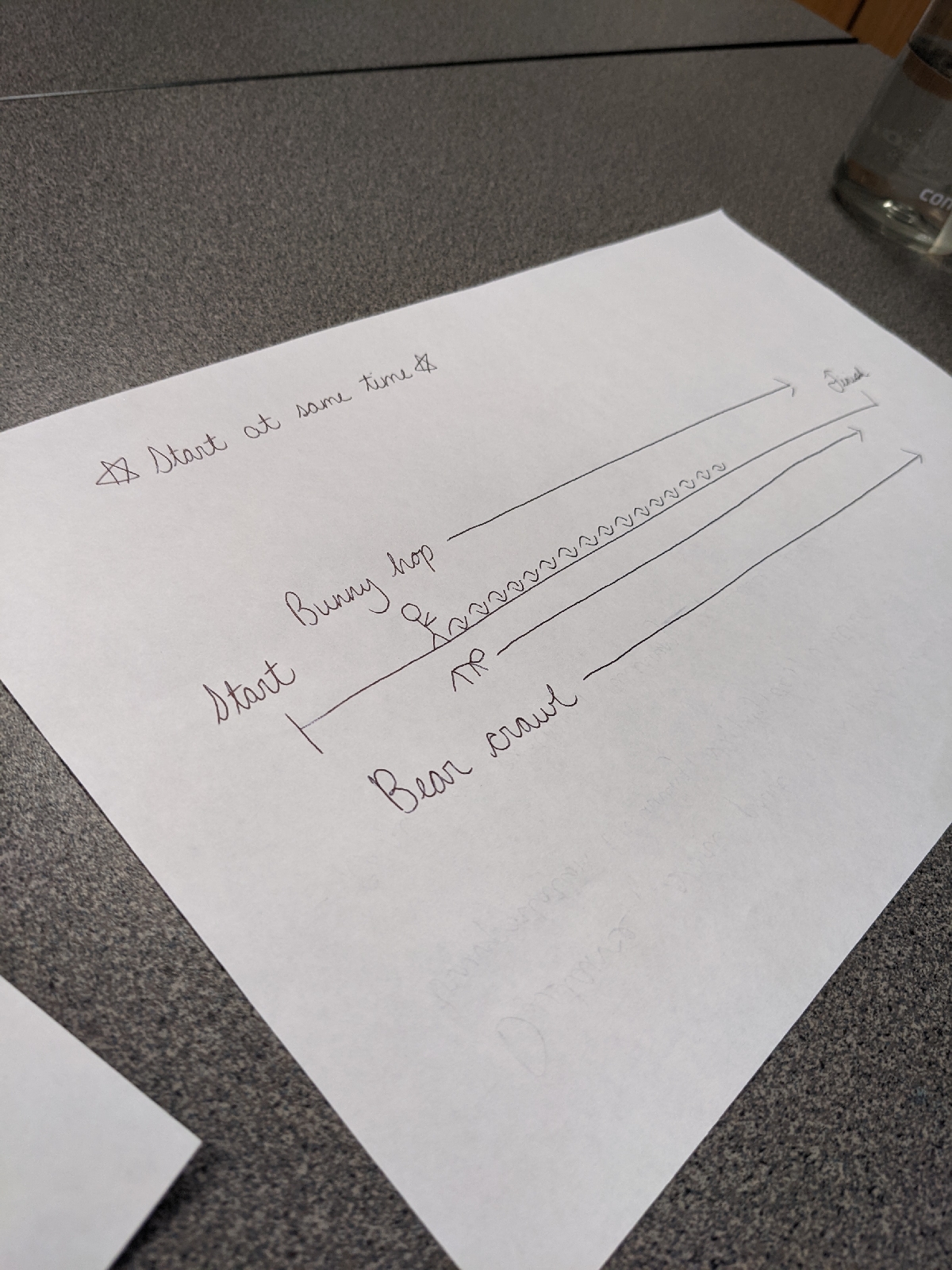
The big question addressed in lab, and a description of what you did.  Week one we as a class focused on motion and the syllabus. We were introduced to the concept of physics being present on the playground. We explored the concept of speed and how to manipulate it. We also went over the syllabus a bit.  A description of what you learned in Thursday's lecture.  In Thursday's lecture, we talked about School of Wild and our syllabus. We talked about the School of Wild for the first fifteen minutes of the lecture. The School of Wild representative told us that we needed to pick between three different subjects they teach to kids that being the Wetlands, Praire, and Raptors. Then, she said we needed to read up on the material for that lesson and prepare questions for September 11's class when she would be in lab. After the School of Wild representative, we spent the reason of the class talking about class expectations and setup. Answer questions about the weekly t...